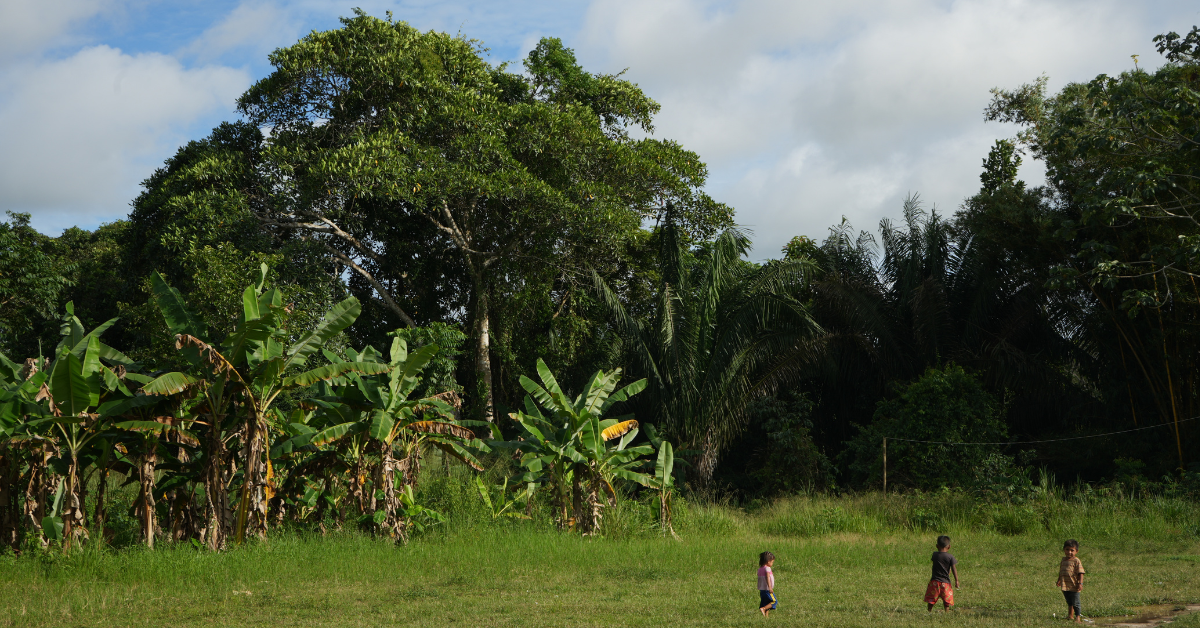
Bringing hope to remote Colombian communities
Yesinia Parada stepped forward beneath a thatched-roof shelter in her village and handed her ID to a Lutheran World Federation (LWF) staff member. In return, she received a small bundle of everyday essentials: shampoo, soap, lotion, a toothbrush, menstrual products and more.
Around her young women and children gathered in the open-air community space, seated on plastic chairs or wooden benches, waiting their turn. The scene unfolded in Caño Claro, a remote Indigenous community in Colombia’s Arauca Department on the border with Venezuela where services are limited and access to basic good can be difficult. For women of menstruating age these dignity kits are more than hygiene supplies. They are rare and precious.
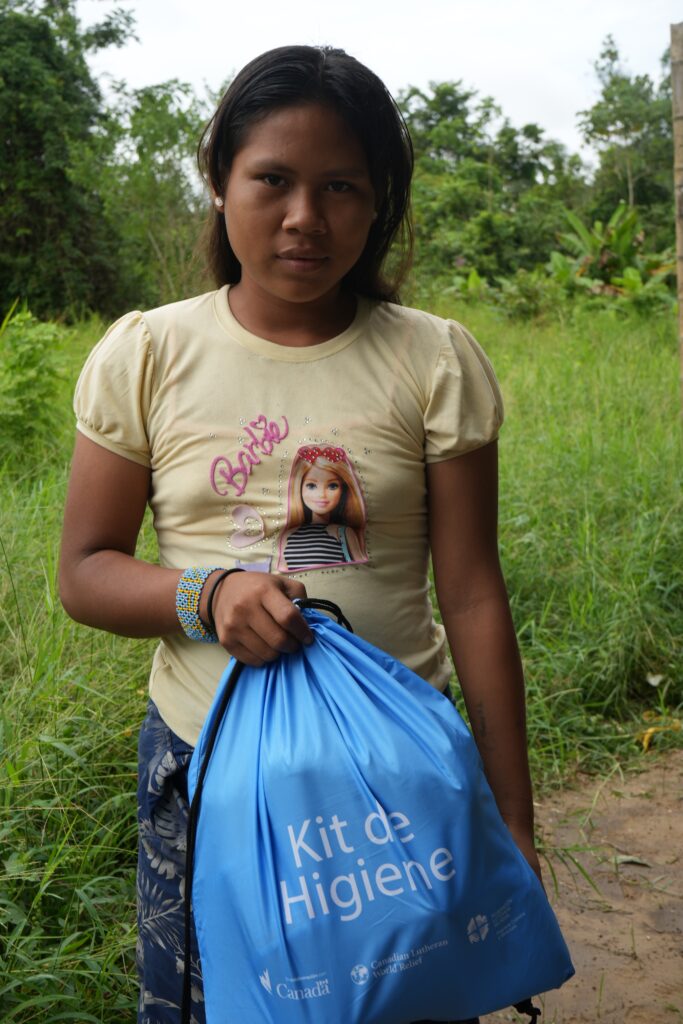
Yesinia Parada, 15, received a dignity kit as part of a CLWR and LWF project helping women and girls access everyday essentials like soap, shampoo and period products. (CLWR photo/Shauna Turnley)
When asked how she felt, Yesinia paused as the question was translated. Then she smiled. “Happy,” she said simply. In her isolated village, these basics are neither easy to access nor affordable, yet here she was, holding them in her hands.
This small moment reflects a much larger reality for women in communities far from the conveniences most of the world takes for granted.
Yesinia’s story began with a blue bag.
A simple dignity kit changed how Yesinia felt about herself.
Today, more girls in Colombia and Haiti are waiting for that same dignity. Your generosity puts the next kit in their hands.
Send a dignity kitReaching Caño Claro
Getting to Caño Claro takes time and careful planning.
Before sunrise, staff from Canadian Lutheran World Relief (CLWR) and LWF gathered for a security briefing ahead of a visit to the remote community. The journey takes more than three hours by road, passing through military checkpoints and areas affected by non-state armed groups. Travel along this route is unpredictable, shaped by ongoing tensions and sporadic violence. Teams were warned to prepare for possible gunfire.
Three vehicles travelled together in a convoy carrying supplies for the community: food, educational materials, dignity kits and water filtration systems. At each checkpoint, the atmosphere shifted — windows down, conversations paused, attention focused.
The paved road eventually ended, giving way to farmland and then narrow, rough tracks through the jungle. Then came two old, unstable wooden bridges. The team had to get out to reinforce them before the vehicles could cross.
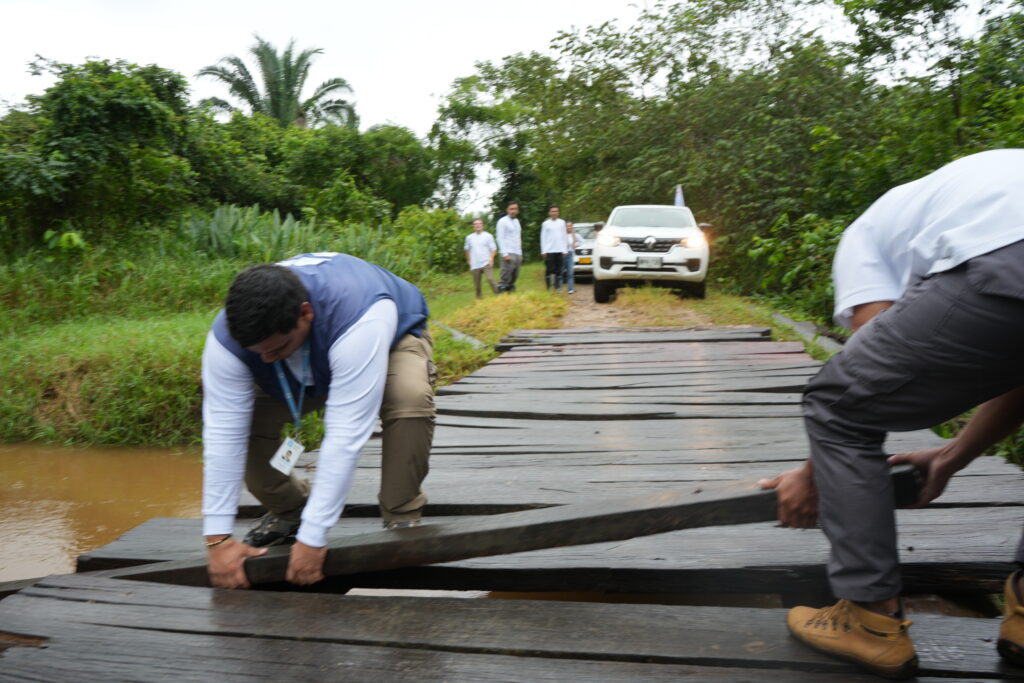
Fabian Giordano Florez Martínez, LWF staff, helps repair wooden planks on a bridge to give the team access to the remote Indigenous community of Caño Claro in Colombia’s Arauca Department. (CLWR photo/Shauna Turnley)
Not long after, the “road” ended entirely. From there, the team continued on foot. Community members met the group along the way and helped carry supplies. Young and old threw supplies over their shoulders as everyone walked the final stretch together.
At the end of the trail lies the Resguardo indígena Caño Claro, which means Clear River, home to about 150 people in 27 families from the Macaguán ethnic group. The community is highly isolated – reaching the nearest health center can take five to eight hours on foot. To provide for their families, most people depend on small-scale farming and hunting, though ongoing conflict has made hunting increasingly difficult and often unsafe.
Water and hygiene support
Access to clean drinking water is one of the most urgent challenges. According to community leader Mauricio Parada, the community was relying on a water pump, which was on loan from the local government. It was removed in December 2025. Residents of Caño Claro do not have the resources to build large-scale water infrastructure, so each home needs its own way to get clean drinking water.
To help make this happen, LWF is distributing 80 water filtration kits across eight Indigenous communities, ensuring every household receives a system. Each kit includes two 20-liter buckets, a bottle of bleach and a cleaning brush. The filter can treat up to 10,000 liters of water and can last up to 10 years, depending on water quality. When the filter reaches the end of its lifespan, the water flow decreases, signaling that it needs cleaning. Community members, including trained water committees, are responsible for maintaining the systems.
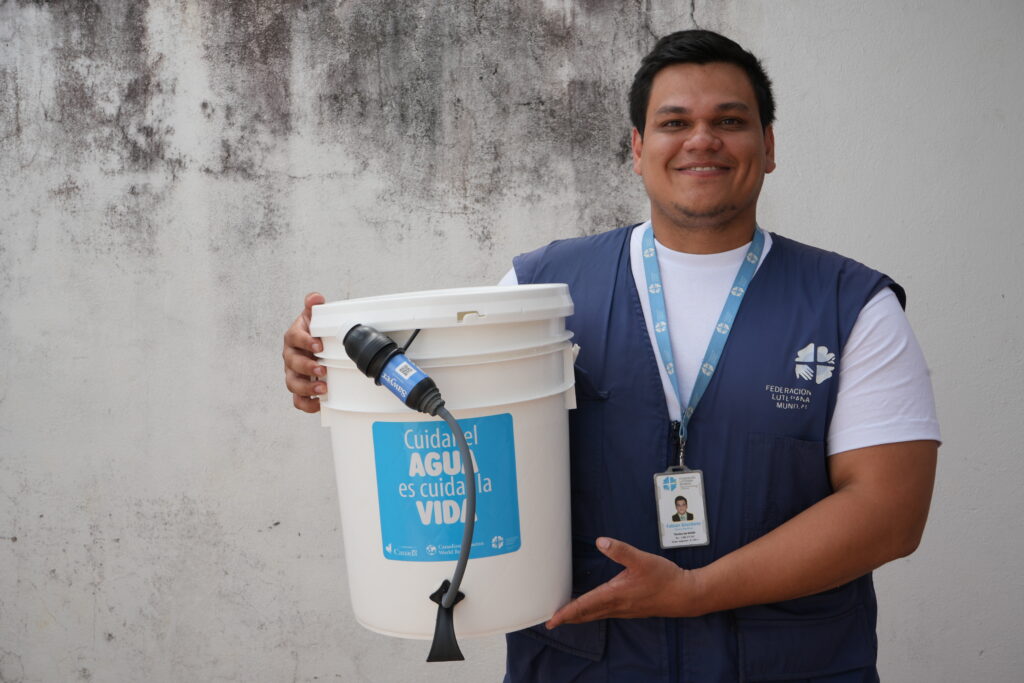
LWF WASH specialist Fabian Giordano Florez Martínez demonstrates how to use the water filtration kits, which cost around CA$111. These kits will help people in remote communities in Colombia access clean drinking water. (CLWR photo/Shauna Turnley)
“Taking care of water is taking care of your life,” says Fabian Giordano Florez Martínez, a WASH specialist with LWF. He plans and carries out projects to make sure people have safe water, proper sanitation and hygiene education to prevent disease.
Fabian says this initiative is especially important in remote communities where access to clean drinking water is difficult and building large-scale water systems is not always possible. “Our first goal is safe [drinking] water,” he explains — water that people can use reliably without immediate risk. Without it, communities face higher chances of waterborne illnesses, skin problems and other preventable health issues.
The total cost of the water filter kits is about 300,000 Colombian pesos, or roughly CA$111.
Alongside water support, dignity kits are given to women and girls. These kits include essential hygiene items that are often hard to find or too expensive because of distance and low or no income.
The initiative behind the impact
These moments of joy in Caño Claro are made possible by a $6.2-million initiative running from January 2025 to mid-2026. It is jointly implemented by CLWR and LWF to support nearly 50,000 people in conflict-affected communities in Colombia and Haiti — especially women and girls.
Thanks to the support of the Government of Canada and the generosity of Canadian Lutherans, communities across both countries can access clean drinking water and everyday essentials such as soap, shampoo and deodorant. By the end of the project, 51 water sources will be rehabilitated, and more than 5,300 women and girls will have access to everyday essentials and menstrual products.
In communities like Caño Claro, these interventions address immediate challenges while also strengthening longer-term resilience.
For Fabian, the work is about making practical progress in complex environments. Providing safe water can significantly improve health outcomes. A dignity kit can meet urgent and everyday needs. Each step contributes to buildingsafer, healthier communities.
But for girls like Yesina – the impact is more immediate. It is not about long-term outcomes but about what changes today. Something as simple as having access to shampoo. And the feeling of happiness that comes with it.
Top image caption: Children play in the open field of Caño Claro, a remote Indigenous community in Colombia’s Arauca Department on the border with Venezuela. (CLWR photo/Shauna Turnley)