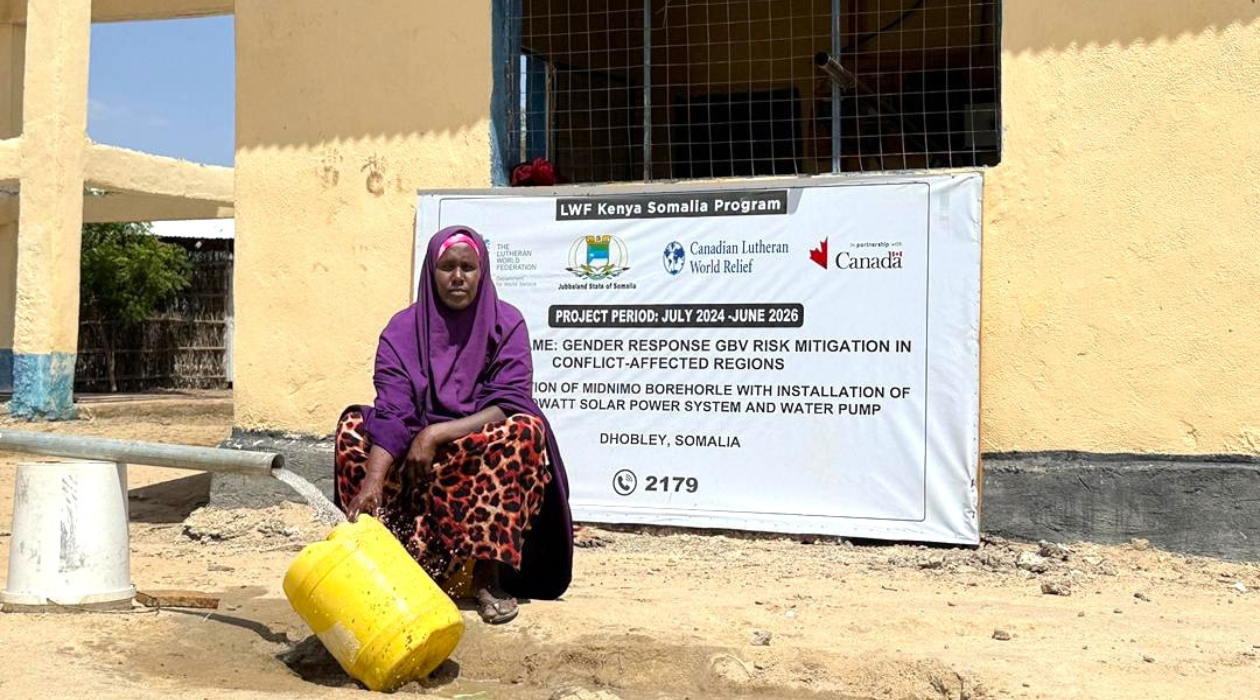
How a water pipeline is restoring dignity for displaced families in Somalia
Ebla Aden Ahmed fled her home in Jilib, Somalia, with her four children when life there became unbearable.
“We lived in constant fear. Armed clashes were happening close to our home, and I worried every day about my children’s safety,” Ebla said. “I left my farm, my house and everything I worked for. All I wanted was a safe place for my children.”
Decades of conflict, extreme weather and limited governance have left millions of Somalis without access to food, health care and basic services. Terrorist groups, including Al Shabaab continue to threaten the security of civilians and limit the movement and access of humanitarian actors. This ongoing conflict and displacement have forced 3.8 million people from their homes.
After days of uncertainty, Ebla and her family arrived in Dhobley, near the Kenyan border, and eventually resettled in the village of Midnimo, one of the area’s internally displaced persons (IDP) settlements. Nearly 250 kilometres from their home, Midnimo offered relative safety from violence, but little else. When the family arrived, they faced another life-threatening danger – the lack of clean water.
“Starting over was hard. We had no water. I felt like I had escaped one danger only to face another,” she said.Water scarcity has become one of the most pressing challenges for communities in southern Somalia, particularly since 2021, according to staff with the Lutheran World Federation (LWF), which works with local partners in the region. Prolonged drought, recurring famine and ongoing conflict have driven waves of displacement, dramatically increasing the population in Dhobley and surrounding villages.
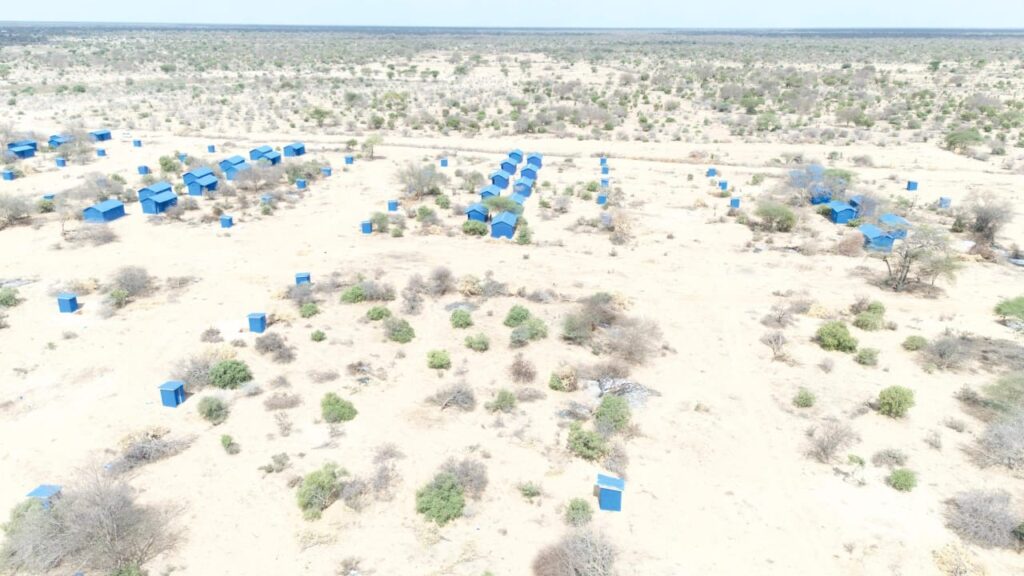
These blue shelters serve displaced people in Somalia, which were built through an LWF project, supported by CLWR and with funding from the Government of Canada.Water taps were installed in each of the eight settlements to help reduce the risk of gender-based violence that women face when collecting water alone. Now, collecting water takes minutes instead of hours. (LWF photo)
As people and livestock converged on the area, pressure mounted on the only existing water supply system, an aging borehole with limited output. The infrastructure was unable to meet demand, leaving families with few options.
The community’s only practical source of groundwater was a single borehole located approximately three kilometres from the village. Long queues formed daily, often stretching for hours under the scorching sun. For women and children, who were primarily responsible for collecting water, the journey posed serious protection risks and health concerns.
Ebla quickly became familiar with this routine.
She joined hundreds of other displaced families forced to wait for hours, sometimes days, as water was rationed. In extreme cases, households went up to three days without access.
“Sometimes we had to drink less [water] so that we could have enough. It broke my heart as a mother,” Ebla said. “Some days I waited the whole day just to get 20 litres. I would leave home early and only return in the late afternoon. There were times I even missed preparing meals for my children.”
Most families relied on harvested rainwater, an increasingly unreliable source amid frequent droughts. When rainwater ran out, households were forced to purchase water delivered by truck, which is an expensive option that pushed already vulnerable families deeper into financial hardship.
Everything changed when LWF rehabilitated the borehole, upgraded the water system and constructed a new pipeline extending directly into Midnimo, which was supported by Canadian Lutheran World Relief (CLWR) and the Government of Canada.
The intervention replaced deteriorated pipes, installed a powerful 15-inch pump and expanded the solar power system to 58 kilowatts, ensuring a steady and reliable supply of clean water. The new pipeline now delivers water directly to the heart of the settlement using clean, renewable energy. Five communal water points, each equipped with six nozzles, were installed near shelter units, allowing up to 30 people to collect water at the same time.
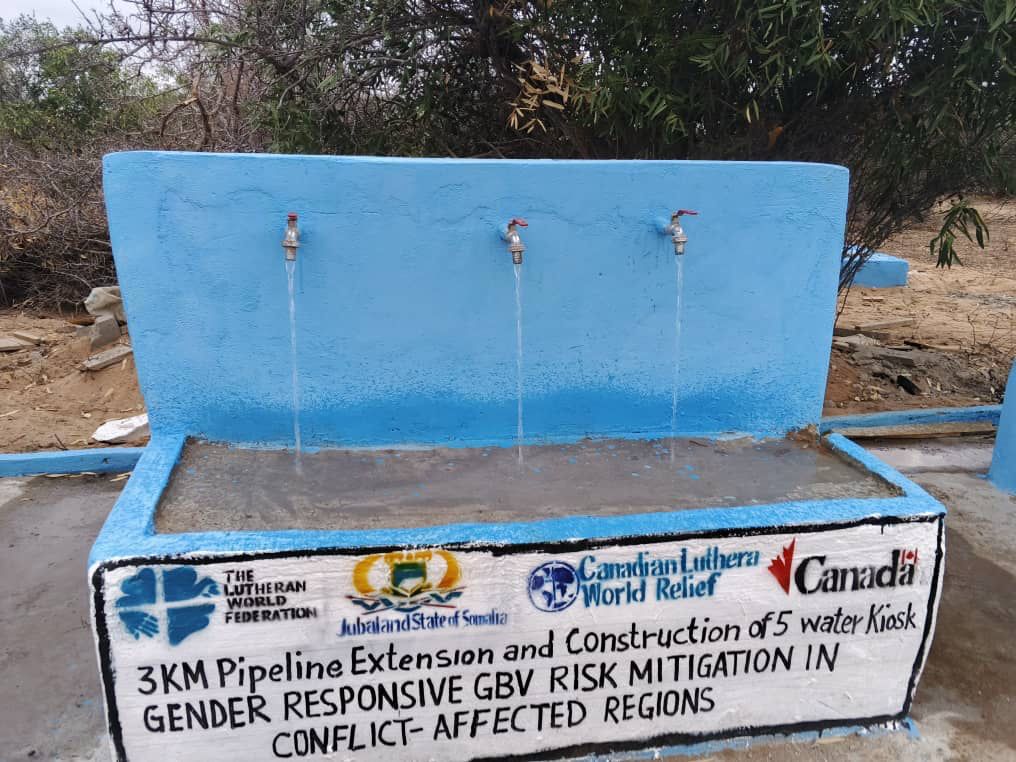
(LWF photo)
For Shafici Hassan, the water systems supervisor at the Midnimo borehole, the impact has been immediate and profound. “When I saw the new system fill the tank in just four hours, I knew life here would never be the same,” Shafici said.
“This life-saving intervention didn’t just bring water to the community; it brought hope, survival and freedom,” he said. “Mothers can now cook on time. When I walk through the water point, I see laughter and joy from families. That is the greatest reward for me. It reminds me every day why this work matters.”
The pipeline extension was designed to improve equitable access to safe water, reduce pressure on limited water points and lower the incidence of water-related diseases. This rehabilitation work helped restore reliable access to clean water for both displaced families and the host community.
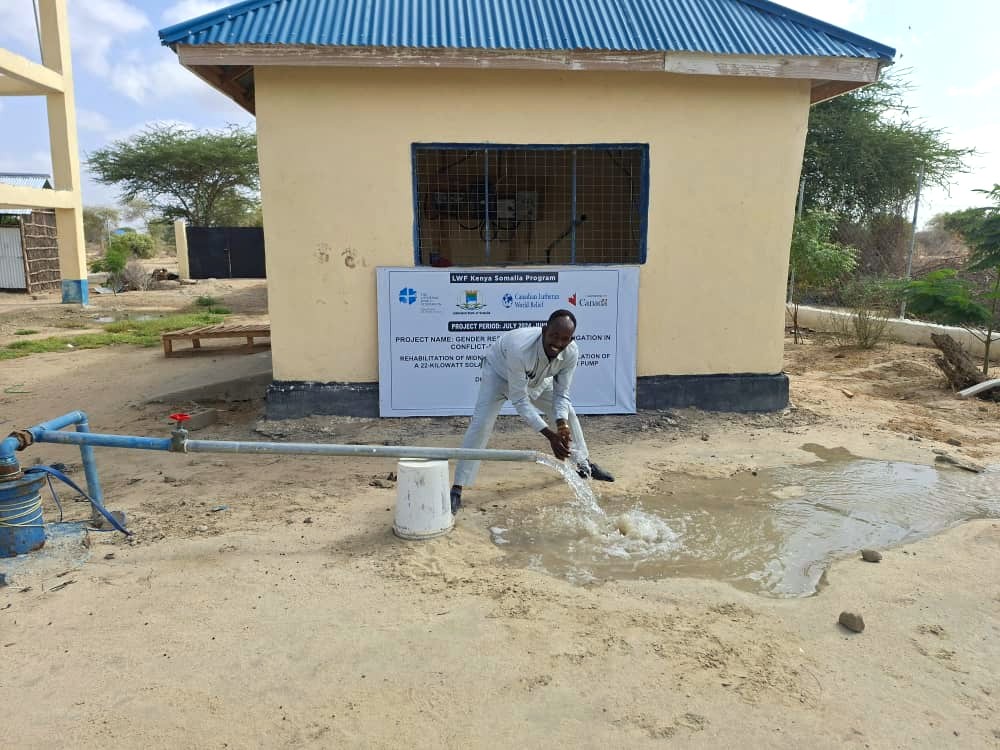
Shafici Hassan, Water Systems Supervisor at the Midnimo borehole, demonstrates the rehabilitated solar-powered water system in Dhobley district, bringing hope to thousands of displaced people. “Before, water scarcity caused frustration and anger…we were living in constant fear,” he said. (LWF photo)
To ensure the system continues to function for years to come, LWF trained Shafici and members of the local water committee in operation and maintenance. Training covered pump monitoring, solar panel cleaning and fair water management, fostering a sense of ownership and accountability.
“Before, we waited for help whenever something broke. Now, we have the skills to fix problems ourselves,” Shafici said. “We are not just using the system but protecting it for the future. This is our responsibility.”
Routine inspections and preventive maintenance by the trained water user committee are expected to keep the system in optimal condition for decades. With consistent upkeep, the pipeline is projected to last up to 20 years.
For Ebla, the change has brought more than convenience, it has restored dignity and peace of mind.
“Now, I can fetch water in minutes instead of hours like before. I have time to cook and care for my family. It feels like a new life,” she said. “This project gave us hope and freedom. Today, I know my family is safe thanks to LWF and CLWR.”